

Twin-spotted Quaker (Anorthoa munda) | Species | ||||||||||||||||||||||||||||
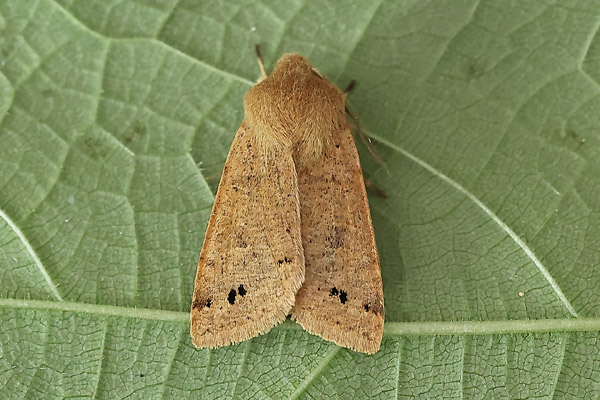 Male. Taken at Aston, Oxon., on March 6th 2026. (© David Hastings) (Canon R6+RF100, f/8, 1/200th, ISO10000, 100mm) DescriptionFamily: Noctuidae (ABH : 73.250) Wing span: 34 - 40mm This species has two black spots on the inner edge of a faint, pale outermost crossline. The forewing is rather broad and curved. The ground colour is light brown, tawny, reddish or greyish-brown. The male has visibly feathered antennae. It is well distributed throughout the British Isles, except the north of Scotland. Its usual habitat is broad-leaved woodland. There is one generation per year, from March to April. It over-winters as a pupa in an underground cocoon. Larvae feed on a wide range of trees and woody plants, including oaks, sallows, Aspen, Ash and Honeysuckle. It comes to light and sugar, and feeds at sallow catkins. Earliest UK sighting: 6th March ; Latest UK sighting: 19th March Sightings
| |||||||||||||||||||||||||||||